Tuesday, August 20, 2013

Early 1860's and Late 1860's: What's the Difference?

{Please bear in mind that I am in no way an expert: I am simply reporting on the trends I have seen, and hoping to educate people so they don't make the same mistakes as I have (yes, I might have once bought silk to make an 1866 ball gown for CW use...)  Please, anyone, chime in if they have any additional information, I'd love to hear it!}

Often, pictures circulate around Pinterest tagged with a vague date of "1860's" and they're hailed as beautiful creations of the Civil War era.  They are all quite beautiful (I think 1865-1869 is probably my favorite half-decade in fashion history), but they should not and cannot be used as an inspiration piece to be worn to a sesquicentennial event, a ball, or any event that is focused on the years of the American Civil War.  Because places like Pinterest and even some museum sites can often be vague, here are some hallmarks of gowns of the late 1860's:

1. Flat fronts


Both gowns shown here were dated "1860's" by their respective pinners on Pinterest.  However, if you look at the skirt of the gown on the top, you can see that there is at least a ten inch panel of unpleated fabric in the front of the skirt.  This is a hallmark of the late 1860's.  This is the most noticeable of all of the trademarks of late 1860's fashions, as most dresses of that era possess this feature.  The gown on the bottom is pleated all the way around, so it is more likely earlier.

2. Shaped skirt panels

On the dress on the top, it is easy to see that the front panel of the gown is shaped (looking at the seam down the front where the stripes go two different directions), and not a straight or "tube" skirt like the dress on the bottom.  This is harder to see on original gowns, fashion plates, and portraits, but easier to notice in original sewing patterns.  This kind of skirt is called a gored skirt, and usually has the regular amount of fullness in the back, but with a flatter shaped front panel.

3. On ball gowns--straight waists


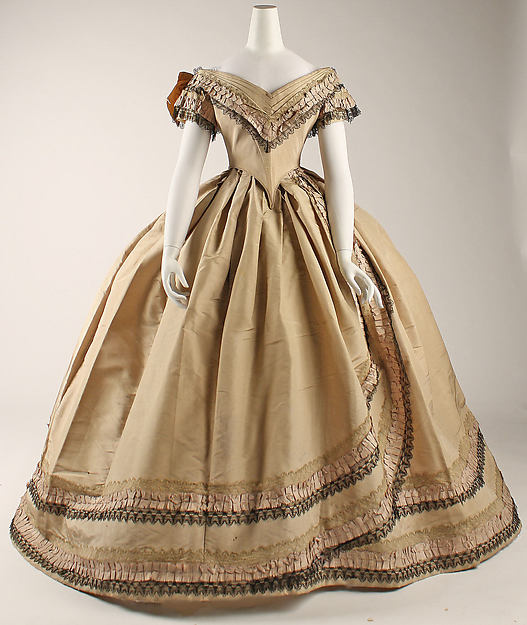
As you can see on the top, this ball gown from the Kent State museum, dated 1860-1869, features a waistline just like you would see on any old day dress or evening dress.  On the bottom, a gown from the Met Museum features a pointed waist.  The pointed waist is one of the hallmarks of the early 1860's ball fashions.  The straight waist for ball wear did not come into fashion until about 1864, and they did not gain in popularity until after the war.

4. Angular and/or unnatural placement of trim


The CDV on the top shows another trademark of the late 1860's, angular bodice trim and/or unnatural placement.  Box-like bodice trim became very popular in 1864, along with other geometrical placements of bodice trim.  This zig-zag is also interesting because it is placed in a random part of the bodice.  During the early 1860's, as I have seen, most bodice trim follows the natural lines of the body and of the bodice itself.  Therefore, a lot of trim along the bodice openings, the arms, and the darts (often continuing to the shoulders) is seen.  The CDV on the bottom shows a woman that has regulated her bodice trim to the line where her yoke begins, which is more indicative of the early 1860's.

5. Skirt Peplums/"Butt fluff"

I have no idea what to call these things, so I'll let the pictures speak for themselves.  These trends scream late 1860's and early 1870's, so it's very important to avoid them if you are making something to wear to early 1860's events.


Two examples of skirt "peplums", for lack of a better word.


And, two examples of "butt fluff".  This includes, but is not limited to, bows, additional fabric, trim, etc.


Thank you everyone for listening!  If you have any questions or additions, feel free to add them in the comments!

Saturday, July 27, 2013

Historical Sew Fortnightly Challenge #15: White

Hello again, everyone!  I have just returned from the Jane Austen festival, which was a lovely time altogether.  It was great seeing old friends and making new ones, and introducing my beau to the world of reenacting!  I wasn't able to make myself anything new for this event, but I did make a waistcoat for David.  It was my first tailoring experience, and I think it turned out pretty nicely!  It also qualifies for the fifteenth HSF challenge.  Yay!

The Challenge: #15: White

Fabric: Ticken from Wm. Booth, Draper for the front and cotton muslin for the lining

Pattern: Kannick's Korner Man's Waistcoats pattern

Year: 1812

Notions: Gutermann polyester thread, eight pewter buttons from Jas. Townsend

How historically accurate is it?: I'd say 50%.  The fabrics are correct, the cut and style is correct, but most of the construction is not.  Because I was pressed for time I had to cut a few corners, but I still did all of the necessary tailoring by hand.

Hours to Complete: 16

First Worn:  The Jane Austen Festival in Louisville, KY

Total Cost:  Including the pattern, $60

I have a few construction pictures, and I of course will include more pictures with my write-up of the Jane Austen Festival as a whole!

Tracing the pattern out

Everything is cut out and ready to go!

Padstitching the collar--with my handy stitch-checker!  This was before I realized that I had soaked the other end in coffee, and frantically attempted to remove the stain.  Lesson learned--spray and wash does nicely on ticken!

The waistcoat before collar, buttons, and buttonholes.


Here it is, in all its glory!  See the dirt stain?  At least I knew how to clean it from the coffee stain :)

Thursday, July 11, 2013

The Amateur Seamstress is now The Deviant Dressmaker!

After returning home from Gettysburg and beginning on a few commission pieces, I realized that I can no longer call myself an amateur.  I have grown a lot through these past two years of sewing, and I think I'm now at the point where it is time for a change!  I have decided to adopt the title of Deviant Dressmaker because, while my main goal is in sewing dresses, I tend to have many little offshoots and other adventures and fun experiences.  The blog is also getting a new look to accompany this new name, so I hope you all enjoy it!  Thank you so much for being my faithful readers, I look forward to many wonderful years with you!


Monday, May 27, 2013

Historical Sew Fortnightly Challenge 11: Squares, Rectangles, and Triangles

A while ago, my dear friend David, a midshipman aboard the HMS Acasta, asked me to sew a shirt for him.  I didn't realize until I received the pattern that it totally fits with the 11th Historical Sew Fortnightly challenge!  I'm quite pleased with how it turned out, and so is its new owner!


The Challenge: #11: Squares, Rectangles, & Triangles
Fabric: 40/60 Linen/Cotton blend
Year: 1790-1820
Notions: Gutermann polyester thread, three mother-of-pearl buttons
How historically accurate is it?: About 90%.  I only sewed interior seams by machine, everything else was done by hand.  The fabric and pattern are accurate.  I'm not sure about the buttons exactly, but they were already in my stash so I used them.
Hours to complete: I didn’t count, as I worked on it on and off.  It felt like an age, though!
First worn: David tried it on once he received it, but other than that he will wear it for the first time at the Louisville Jane Austen festival.
Total cost: About $48 including the cost of the pattern.

And now, pictures!


Wednesday, May 22, 2013

New Livejournal!

Hello everyone!  I have decided to start a companion live journal in order to be able to post in small installments in order to show my progress.  The link can be found in the sidebar to the right, but just in case you can't find it, it's here!  Don't worry, I'll still be posting here regularly with research and costume master posts, you'll just be able to better keep track of me on my live journal.  Anyway, off to sewing now!  Allons-y!

Tuesday, March 19, 2013

Lavender in the Mid-19th Century

Hello everyone! I'm sorry for being such a bad blogger.  I haven't had much time to work on garments so therefore I haven't posted very much :( but very soon I'll be out of school and sewing up a storm for the summer reenacting season!

Anyway, in preparation for finishing my PhD lavender sheer (project half done, thank you Dreamstress for the lovely acronym!) I've been on a pinning spree of lavender dresses in the mid-19th century.  I'll let the garments speak for themselves--they are all quite lovely (and I want every single one of them!)


Have a lovely day, everyone!